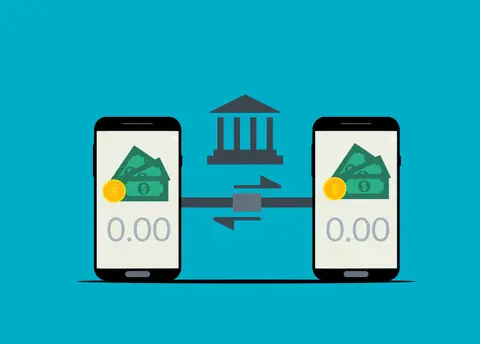
P2P is how most people in Saudi Arabia actually buy crypto with riyals. No exchange has a SAR bank account you can wire money to, so the big platforms run a marketplace instead: a seller posts an ad for USDT at, say, 3.77 SAR, you pay them through STC Pay or Al Rajhi, and the exchange keeps the coins locked until the seller confirms your money arrived. Done right it takes ten minutes and costs well under 2%. Done wrong it is how most of the scam stories in Saudi crypto groups begin.
This is the hub page for P2P in the Kingdom. The payment-rail pages (STC Pay, urpay, AlinmaPay, bank transfer) go into each method; this page covers the mechanics, the platforms, the costs and, at length, the scams. One legal sentence first: crypto is not prohibited for individuals in Saudi Arabia, but it is unregulated, no exchange holds a Saudi licence, and the 2018 Standing Committee statement says nobody is licensed to deal in virtual currencies. Our legal page has the full picture.
How P2P escrow actually works
Think of the exchange as a notary that holds the goods. When a seller posts an ad, the platform locks the amount of USDT they are offering in escrowEscrowA holding account controlled by the exchange, not by either trader. The crypto sits there until the seller confirms payment or an arbitrator decides who gets it.. When you open an order against that ad, the seller cannot withdraw those coins, and you get a payment window, usually 15 to 30 minutes, to send riyals through whatever method the ad lists. You press "Transferred, notify seller", the seller checks their bank or STC Pay app, and releases. The USDT lands in your exchange wallet instantly. If the seller never releases, the coins stay locked and you appeal (see disputes).
Two words you will see everywhere: maker and takerMaker / takerThe maker posts an ad with a price and waits; the taker accepts an existing ad. Fees and obligations differ for each side.. The maker posts the ad and sets the price; the taker fills it. As a beginner you are almost always a taker. Makers on the SAR market are mostly merchantsMerchant (verified advertiser)A P2P trader who passed extra verification and deposit requirements with the exchange and carries a badge. Not a licence, but a higher bar than a random account., traders who passed extra checks and posted a deposit with the platform. The badge is not a guarantee; it is a filter. Next to it you will see the two numbers that matter more: completed orders (hundreds or thousands is good) and completion rate (look for 95% and above).
Binance, Bybit, OKX and Bitget side by side
Four international exchanges run SAR P2P markets that Saudi residents use. None of them names Saudi Arabia on its restricted-country list, and none of them is licensed here. The table sticks to what we could source; "reported" means independent test reports rather than the platform's own pages.
| What | Binance | Bybit | OKX | Bitget |
|---|---|---|---|---|
| SAR payment methods | urpay and Liv. KSA official (29 Apr 2022); STC Pay, Al Rajhi, SNB, bank transfer reported | Al Rajhi, SNB, Alinma, STC Pay, SAB reported | Bank transfer and STC Pay reported | Bank transfer only reported |
| P2P fee | 0.05 USDT flat taker fee per order on USDT pairs (official, since 19 Mar 2024); SAR maker rate not published | 0% reported | Not published for SAR | Not published for SAR |
| KYC documents | Government ID plus proof of address (Binance Square guide); Iqama acceptance not confirmed | National ID or Iqama plus selfie (reported) | Not documented for Saudi users | Not documented for Saudi users |
| Saudi Arabia on restricted list? | No | No (article last updated 7 May 2026) | No; P2P restricted only in Brazil, Eritrea, South Korea, UK | No (terms of 20 Oct 2026) |
| Our review | Binance in KSA | Bybit in KSA | OKX in KSA | Bitget in KSA |
Two footnotes. KuCoin launched a SAR P2P market on 15 July 2021 with "bank transfer and more to come", but current activity there is not something we could verify, so it is not in the table. And "Gulf Binance" is a Thai joint venture, not a Gulf licence; if you see it quoted as proof that Binance is "approved" in the region, it is a misreading.
Official versus reported payment methods
This distinction matters more than most guides admit. The only SAR payment methods an exchange has formally announced are urpay (Al Rajhi's wallet) and Liv. KSA, added to Binance P2P on 29 April 2022. Everything else you see on ads, STC Pay, Al Rajhi, SNB, Riyad Bank, Alinma, Bank Albilad and generic "bank transfer", is something merchants select and test reports confirm, not something Binance, Bybit or OKX has published a Saudi-specific list for. In practice STC Pay and bank transfer are the methods you will see most, and they clear in seconds to minutes during Saudi banking hours.
None of the Saudi payment apps has a public position on crypto. stc pay now operates under stc bank, a SAMA-supervised bank, and its published terms contain no clause on virtual currencies. urpay, AlinmaPay and D360 are equally silent. That means two things: nobody has told you that you may not use them for a P2P payment, and nobody has promised they will not ask questions. Keep the payment note blank or neutral (your order number is fine; "USDT" or "crypto" is asking for a compliance query), and never send from an account that is not in your own name.
The premium over 3.75
The riyal has been pegged at 3.75 per US dollar since 1986, and USDT is designed to track the dollar, so a "fair" USDT price is 3.75 SAR. P2P ads sit above that. The gap is the premiumPremiumThe percentage by which a P2P seller's price exceeds the reference rate. It is the real cost of the route, because platform fees are tiny by comparison., and it is the actual cost of buying this way. Independent test reports describe sellers pricing roughly 0.3–1% above the dollar rate during Saudi banking hours, with a full buy-and-sell cycle usually costing under 1.5%. We have no live feed of our own, so treat those as estimates and check the order book yourself: the calculator below turns a seller's quoted price into a percentage and an effective dollar rate.
P2P premium calculator
The riyal has been pegged at 3.75 per US dollar since 1986. Anything above that is the cost of the route, not of the coin.
Three things push the premium up: weekends and evenings when fewer merchants are online, small order sizes (ads for SAR 200 cost more per riyal than ads for SAR 20,000), and payment methods with fewer sellers. If a quote is 3% or more above 3.75, do not accept it; a card purchase at a published fee may genuinely be cheaper at that point.
Fees and limits
Platform fees are the small part. Binance charges takers a flat 0.05 USDT per order on USDT pairs in the SAR market, in force since 19 March 2024; on a SAR 5,000 order that is roughly 0.19 SAR, so the premium dwarfs it. Binance ran a zero-maker-fee promotion for the SAR market in December 2022, but the current SAR maker rate is not on a page we could read. Bybit P2P is reported as fee-free; OKX and Bitget publish no SAR P2P fee that we found. Spot trading after you hold USDT is a different fee (Binance 0.1% base, reported).
Limits are set ad by ad. Each merchant states a minimum and maximum for a single order, and the exchange may cap your daily P2P volume by verification level; those caps are not published for Saudi accounts, so expect to discover them in the app. Your bank or wallet adds its own ceiling: STC Pay and bank transfers have per-transaction and daily limits that have nothing to do with crypto. For large sums you split orders, or you stop using P2P and read the OTC page.
KYC with a National ID or Iqama
P2P needs a fully verified account on every platform, which means KYCKYCKnow your customer: the identity check an exchange runs before letting you trade, usually a government ID, a selfie and sometimes proof of address. with a government document and a selfie. Test reports say Bybit accepts either the Saudi National ID or an IqamaIqamaThe Saudi residence permit card issued to foreign residents. Some platforms accept it as a primary ID; others ask for a passport.. Binance asks for an ID plus proof of address, and whether an Iqama alone is enough there is not confirmed on its own pages. Expats should keep a passport ready as a fallback and read our KYC guide for Iqama holders. Two practical points: the name on your bank account and the name on your exchange profile must match exactly, and a verified account is the only kind that can open an appeal with any chance of success.
Want a first purchase without a seller?A Saudi Visa or Mastercard buys USDT in US dollars with a published fee range and no escrow to think about. P2P can come later.
Create an accountA first P2P buy, step by step
- Verify the account and add a payment method
Complete KYC, enable 2FA, then add STC Pay, urpay or your bank account under the exact name shown on your exchange profile.
- Open the P2P tab, choose USDT, set fiat to SAR
Filter by your payment method and by amount. Sort by price, then skip ads from traders with under a few hundred completed orders or a completion rate below 95%.
- Read the ad terms before you click Buy
Merchants write conditions: no third-party payments, no payment notes, specific banks only. Breaking a condition is grounds for them to refuse release.
- Pay from your own account within the window
Send the exact amount through the method you selected. Leave the note blank or use the order number. Then press "Transferred" inside the order.
- Wait for release; appeal if needed
Most releases take 1–10 minutes. If the timer runs out with no release, open an appeal with your payment proof. Never cancel an order you have already paid.
- Move what you are not trading
USDT sitting on an unlicensed exchange is a counterparty risk. Send long-term holdings to a wallet you control; TRC-20 is the cheapest USDT network.
Selling via P2P
Selling is the mirror image, and it is where the money is actually at risk, because now you are the one releasing crypto. You post an ad or accept a buyer's ad, the exchange locks your USDT in escrow, the buyer sends riyals to your STC Pay or bank account, and you release once you see the money. The Binance guide stresses the sequence: open your banking app, confirm the exact amount from a sender whose name matches the buyer, then release. A notification is not a confirmation; a screenshot is not a confirmation. Our sell page compares P2P with bank withdrawals from a Gulf exchange and with OTC, and covers what your bank may ask about the inbound money.
The scam catalogue
The 2018 Standing Committee statement and the 2019 Ministry of Finance warning both talk about fictitious contracts and transfers to unknown parties. That is a fair description of P2P fraud, which rarely involves hacking and almost always involves persuasion. Here is every pattern we know, with the one habit that defeats it.
Fake receipts and edited screenshots. A buyer sends a doctored STC Pay or bank screenshot and asks you to release. Defeat: your own banking app is the only source of truth. Nothing else counts.
Release-first pressure. "I already paid, my bank is slow, please release, I have a good rating." Sometimes paired with a fake SMS from a spoofed bank sender. Defeat: the escrow exists precisely so that nobody has to trust anybody. If the money is not in your account, the order is not complete.
Third-party payments and account freezes. A buyer pays from someone else's account, often a relative or a "business partner". Either the funds are stolen, in which case the real owner disputes the transfer and your bank reviews your account, or the buyer wants a way to claim later that they never paid. Defeat: reject any payment whose sender name is not the buyer's verified name, and say so in your ad. We found no documented Saudi case of a bank freezing an account over P2P, but AML reviews of unusual inbound transfers are a standard bank procedure anywhere.
Chargeback-style reversals. STC Pay and SARIE transfers are generally final, but a sender can still file a fraud claim with their bank and have a transfer investigated. Combined with a stolen account, that leaves you without the riyals and without the USDT. Defeat: trade with merchants and high-completion accounts, keep order sizes in line with your normal banking, and keep records.
Off-platform chats. "Let us continue on WhatsApp or Telegram, better rate." The moment a conversation leaves the exchange chat, the arbitrator cannot see it and the escrow no longer protects the deal. Defeat: everything stays inside the order.
"Customer support" impersonation. Someone messages claiming to be Binance or Bybit support and asks you to release, to "verify" by sending USDT to an address, or to share a code. Exchanges never ask for that in a P2P chat. Defeat: support is reached only through the app's help centre, and a support agent cannot release escrow on your behalf.
Triangulation fraud. The nastiest one. A scammer sells something fake to a victim elsewhere, tells the victim to pay "the seller", and gives them your bank details from a P2P order they opened with you. The victim's money lands in your account, you release USDT to the scammer, and weeks later the victim's bank comes asking you about fraud. Defeat: again, sender name must equal buyer name, and keep the order record so you can show the bank exactly what happened.
Ad-level traps. Prices far below market (a lure to get you to pay a "deposit" outside the platform), ads that insist on payment notes like "gift" or "loan", and merchants who ask for your ID photo "for compliance". The scams page covers the wider patterns, including fake exchanges and investment groups.
Disputes and appeals
Every major P2P platform has the same basic process. Inside the order there is an "Appeal" button that becomes available once the payment window ends or when either side flags a problem. You choose a reason, upload evidence (a PDF statement or a full-screen banking screenshot showing the sender, amount, time and reference), and the counterparty gets a chance to respond. A platform arbitrator then reads the chat, checks the evidence and either releases the escrow to the buyer or returns it to the seller. During the appeal the crypto stays locked; neither side can touch it. Timelines vary from hours to a few days, and the side that kept everything inside the order and paid from a matching account wins almost by default.
What an appeal cannot do is recover riyals you sent outside the platform, to the wrong account, or against a cancelled order, and it cannot help if your own account was unverified. Nor is there a Saudi authority to escalate to: the 2018 statement is explicit that nobody is licensed, so SAMA and the CMA do not mediate P2P disputes. The Standing Committee does ask the public to report suspicious offers through the SAMA and CMA websites, which is worth doing for outright fraud, but it is not a refund channel. Your protection is the escrow, your records, and the habit of never releasing on anything but your own bank balance.
If after reading all this P2P feels like more administration than you want for a first purchase, that is a reasonable conclusion. A card purchase costs a published fee instead of a premium and removes the counterparty entirely; P2P earns its place once you are moving riyal amounts that make the premium worth the effort, and the exchange comparison lays out both routes.
Frequently asked questions
Is P2P crypto trading allowed in Saudi Arabia?
It is not prohibited for individuals, but it is unregulated. No exchange holds a Saudi licence, SAMA-supervised banks and payment apps do not offer crypto services, and the 2018 Standing Committee statement says nobody is licensed to deal in virtual currencies. A riyal transfer between two individuals is an ordinary domestic payment; what you buy with it has no Saudi investor protection.
Which payment methods work on Binance P2P in SAR?
Binance officially added urpay and Liv. KSA to its SAR P2P market on 29 April 2022. STC Pay, Al Rajhi, SNB, Alinma and plain bank transfer appear on ads according to independent test reports, but Binance has not published a Saudi-specific list. mada and Western Union are not documented as P2P methods.
Does Binance P2P charge a fee in Saudi Arabia?
Yes. Since 19 March 2024 Binance applies a flat taker fee of 0.05 USDT per order on USDT pairs in the SAR market, so the old line that P2P is free is no longer accurate. Maker fees for SAR are not published on a page we could read. Bybit P2P is reported as 0% in test reports; OKX and Bitget do not publish SAR P2P fees.
Can I verify a Binance or Bybit account with an Iqama?
Test reports say Bybit accepts a Saudi National ID or an Iqama plus a selfie. Binance asks for a government ID and proof of address; whether an Iqama alone is enough is not confirmed on its own pages. Expats should keep their passport ready as a fallback. Our KYC guide for Iqama holders covers the details.
Why is USDT more than 3.75 riyals on P2P?
The riyal is pegged at 3.75 per US dollar, but P2P sellers set their own prices and add a small premium for the convenience of paying through STC Pay or a bank. Test reports put the usual mark-up at well under 2%. Anything far above that is either a thin order book or a seller you should skip.
What do I do if the seller does not release my crypto?
Do not cancel the order and do not pay again. Open an appeal inside the order, upload the bank or STC Pay proof of payment, and let the platform arbitrate. The crypto stays locked in escrow until the dispute is resolved. Keep all communication inside the exchange chat so the arbitrator can read it.
Can my bank freeze my account for P2P transfers?
We found no documented Saudi case of a bank freezing an account specifically for P2P crypto payments, but any bank can review unusual inbound transfers under its AML rules. Keep amounts in line with your normal activity, never accept payments from third parties, and keep order records so you can explain a transfer if asked.
Sources and references
- Binance — P2P adds urpay and Liv. KSA as SAR payment methods (29 Apr 2022)
- Binance — flat 0.05 USDT taker fee on USDT pairs in selected fiat markets incl. SAR (from 19 Mar 2024)
- Binance — zero maker fees in the SAR and MAD P2P markets (Dec 2022 promotion)
- Binance Square — P2P safety guide: verify funds, completion rate, 2FA, appeals
- KuCoin — launch of P2P fiat trade for the Saudi riyal market (15 Jul 2021)
- OKX — risk and compliance disclosure (restricted jurisdictions, P2P restrictions)
- Bitget — terms of use (restricted jurisdictions)
- Bybit — service restricted countries
- stc bank — general terms and conditions (no crypto clause)
- Saudi Central Bank — Standing Committee warning on virtual currencies (12 Aug 2018)
Ready for your first coin?
Sign-up and the ID check take a few minutes. Then buy Bitcoin, USDT or Pi with a Visa or Mastercard, or with Apple Pay.
Global platform operating since 2013 · registered with FinCEN (US) and the FCA (UK). Check availability in your country before signing up.